

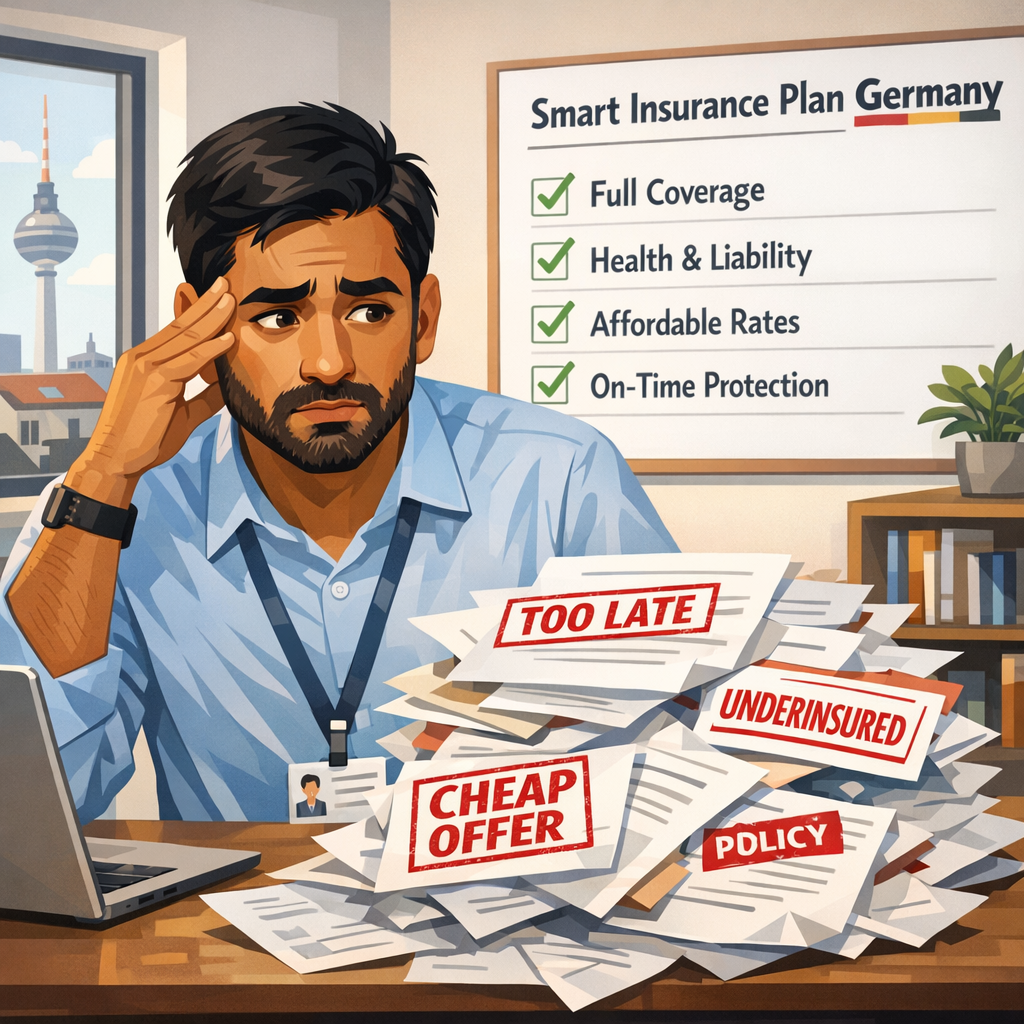
The most common insurance mistakes Indian expats in Germany make – and how to avoid them
Why expats in Germany are especially prone to insurance mistakes
“I’ll just do the bare minimum for now; we’ll sort out the rest later.” – this is how many expats sound when it comes to insurance in Germany. It is understandable: in the first few months, the to‑do list is long – visa, apartment, daycare, new job. But it is exactly in this phase that decisions are often made which turn out to be expensive or hard to correct years later.
This article summarizes the most common insurance mistakes Neodirect repeatedly sees in consultations with Indian professionals and families – and shows practical ways to avoid them. Unlike general guides, it explicitly addresses the situation of Indian expats: many work in well‑paid IT or engineering jobs, support relatives in India financially and at the same time want to build wealth in Germany.
International portals such as “Insurancy – How to Get Insurance in Germany as an Expat”, “Live in Germany – Insurance Guide for Expats in Germany” and the family guides from “Health‑Insurance‑in‑Germany” explain which insurances are generally important. However, they rarely address typical thinking errors, such as underestimating liability risks, focusing only on the cheapest premium, or neglecting long‑term topics like occupational disability and retirement planning.
Instead of overwhelming you with product names, this article works with scenarios: What happens if you cause major damage in your rental apartment without having liability insurance? What are the consequences if, after a few years with a family, you find yourself “stuck” in an unsuitable health insurance system? And how does a cheap but incomplete policy differ from a strategy that realistically protects your income, your family and your future?
The goal is not to create fear, but to create clarity. Once you know the typical mistakes, you can consciously decide where you want to save – and where it is worth investing a bit more to protect yourself and your family in the long term.
The 7 most common insurance mistakes Indian expats make – and how to avoid them
Many Indian expats enter the German insurance market with the same goals: as little bureaucracy as possible, low monthly costs and quick online sign‑ups – ideally in English. However, this exact combination regularly leads to the biggest mistakes. In this section, we present seven typical pitfalls and show how to avoid them.
Mistake 1:
Treating health insurance as a pure visa formality
If you see health insurance only as a visa requirement and choose any random expat policy, you risk gaps in coverage for pregnancy, chronic illnesses or long‑term stays. Portals like “Insurancy – How to Get Insurance in Germany as an Expat” and “Live in Germany – Insurance Guide for Expats in Germany” stress that incoming tariffs are often time‑limited and do not have the same legal status as public health insurance (GKV) or full private health insurance (PKV). If you plan to stay longer or bring your family over, you should organise the transition to a permanent system at an early stage.
Mistake 2:
Postponing essential basic insurance policies
Many newcomers focus on health insurance and the visa and push topics such as private liability, household contents or legal expenses insurance to “later”. Yet especially in the first years – with a new rental apartment, unfamiliar traffic and unknown authorities – the risk of expensive damages and conflicts is high. IamExpat and other expat guides therefore consider liability insurance to be almost indispensable; legal protection, especially for tenancy and employment law, can also defuse existential conflicts.
Mistake 3:
Only looking at the lowest premium
Cheap online offers without personal advice often cut corners at crucial points: low coverage limits, many exclusions or missing modules such as damage to rented property, claims caused by children not yet legally liable, or employment‑related legal protection. Articles such as “The Biggest Insurance Mistakes Expats Make in Germany” by Insurancy and “8 Common Insurance Mistakes in Germany” by MW Expat show how expensive this “savings strategy” can become in the event of a claim.
Mistake 4:
Buying policies in isolation
If you buy health, liability, household contents, legal expenses and disability insurance from completely different providers, you quickly lose track. This creates gaps (e.g. no tenancy legal protection, no cover for children) or double insurance. A better approach is an overall concept that considers risks, budget and life plans together – and where an independent broker like Neodirect bundles all contracts in one digital overview.
Mistake 5:
Ignoring family planning and return options
Decisions such as switching from GKV to PKV are often made without considering plans for children, planned self‑employment or a possible return to India. Independent family guides like “Health-Insurance-in-Germany – Health Insurance for Expat Families” explicitly point out that private health insurance can quickly become expensive for growing families and that returning to public health insurance can be difficult.
Mistake 6:
No regular check‑ups
Life situations change quickly: salary increases, children arrive, a property is purchased, someone becomes self‑employed. Without an annual insurance check, outdated tariffs remain in place, important modules are missing or premiums are higher than necessary. Platforms such as “Live in Germany” therefore recommend reviewing your insurance setup at least once a year.
Mistake 7:
Keeping health and financial data unstructured
Especially for products such as occupational disability insurance or private health insurance, complete documentation and honest information are crucial. If you do not collect doctor’s letters, medication lists or income statements, you risk delays, premium surcharges or even exclusions of benefits.
All these mistakes have one thing in common: they do not arise from a lack of interest, but from time pressure, information overload and language barriers. This is exactly where a structured, English‑language advisory process can make the difference – and prevent expensive wrong decisions from affecting you for years.
How Neodirect supports Indian expats from day one: strategies, annual check‑ups and practical assistance in case of a claim
Instead of being guided by individual products, advertising claims and price comparisons, Indian expats benefit most from a clear framework: Which risks are existential, which are merely inconvenient – and how much budget is realistically available per month? In this final section, we show what such a framework can look like in practice and what role Neodirect plays in it.
A proven approach is to divide insurance into three levels:
1. Essential protection
This includes health insurance, private liability insurance, for families with children a solid death cover (term life insurance) and – for high earners – occupational disability insurance. These components protect your health, income and basic obligations such as rent, loans and financial support for family members in India.
2. Everyday and property protection
In this category you find household contents insurance for your apartment, legal expenses insurance (especially for tenancy and employment law) and – if you own a vehicle – car insurance with sensibly chosen comprehensive cover. These products prevent a burglary, a dispute with your landlord or an accident from eating up your savings.
3. Future and wealth building
This includes private retirement provision (e.g. tax‑optimised basic pensions or ETF‑based solutions), supplementary accident insurance or specific covers linked to property financing. You should only start building this level once the foundation is in place and the ongoing costs of the first two levels are stably affordable.
Neodirect supports Indian expats in three phases:
• Analysis: We record income, family structure, plans for your stay and existing insurances – in many cases there are already policies from India whose effect within the German system needs to be clarified.
• Implementation: Based on the levels described above, we select concrete tariffs from different providers, always focusing on English documentation, good claims handling and an appropriate price‑performance ratio.
• Maintenance: With digital tools, clients keep an overview of all contracts; together we review once a year whether sums insured, modules and providers still fit or should be adjusted.
In parallel, we deliberately refer to neutral information sources such as Insurancy, Live in Germany or the family guides from Health‑Insurance‑in‑Germany, so that our clients can read up independently at any time and understand decisions.
The result is a “Smart Insurance Plan Germany” that does not just promise low premiums, but above all stability: you know which risks are covered, which you consciously bear yourself – and whom to contact in an emergency. This turns the initial uncertainty in the German insurance jungle into a structured, predictable security strategy for your life in Germany.
Indian expats can use all three blog topics described here – pre‑move checklist, family health insurance and typical mistakes – as a common thread to classify their own situation. Neodirect supports them as a long‑term partner who understands the specifics of the Indian community and translates German specialist knowledge into clear English (and other languages if required).